
Nymph Patterns
The Ones That Generally Work

Note: There is some pretty dry, academic stuff until you reach the section titled “Impact of Drift on Trout Feeding Habits.” You can skip to that spot for the gist of this stuff. I’ve added references in case you want the gory details.
Various forms of aquatic macro invertebrates move in and through the water column at times. When they do this they’re available for predation by the trout. Unless there are bugs available on the surface trout will, per force, feed subsurface. That leaves them with the choice of larger prey such as other fish, crustaceans such as crayfish, or these macro invertebrates.
These invertebrates, which I will call bugs, consist of a variety of nymphs, larvae and pupae, as well as annelids (worms), crustaceans such as scuds and cressbugs, etc. The drift behavior of these bugs falls into two classes - active and passive. Active drift occurs when the bugs do so of their own volition and passive drift is when some other effect causes the drift.
Passive drift is typically caused by some catastrophic event - a flush of water due to rain or a dam discharge, a rock or piece of wood tumbling in stream due to water pressure, some other animal moving in the water (the San Juan two-step is an example), etc. These events are stochastic and infrequent. While catastrophic drift may cause bugs to come by a trout it is not a regular and reliable mechanism for the supply of food. And catastrophic drift is often accompanied by less than favorable conditions for trout feeding such as a spate, snow runoff or dam discharges.
Active drift occurs for behavioral reasons. Terrestrial adults that have metamorphosed from aquatic invertebrate deposit their eggs in clusters. These eggs hatch and as the hatchlings grow they need to start spreading out in order to find adequate food and space. That’s one reason for behavioral drift. The bulk of immature stages (nymphs, larva, etc.) live in riffles and runs. However, they hatch in locations more conducive to hatching. In order to so so they drift to those locations. Anyone who’s fished areas with populations of Grannom caddis (Brachycentrus sp.) has seen the collection of larva in the slow water in the week or two prior to the hatch. Before that these cases were always in the faster water.
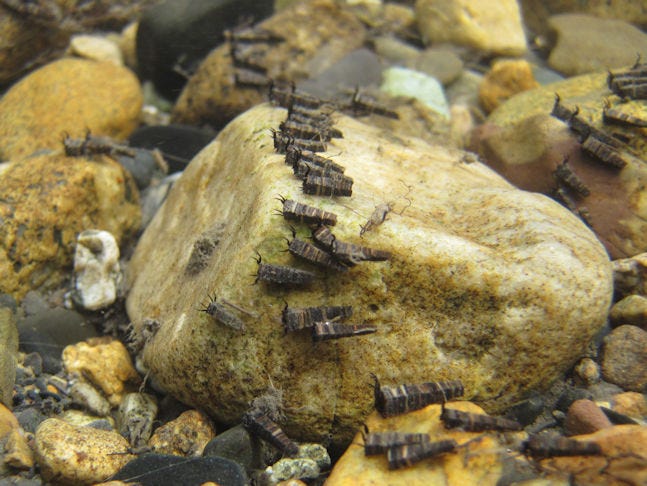
Then there is the actual hatch behavior. Gary LaFontaine talks about how the Brachycentrus species pupae will drift for hundreds of feet as they hatch, making a deep sparkle pupa or a shiny soft hackle a killer. Other bugs do the same thing. During a hatch the water column actually carries more drifting bugs than what one sees in the air since some fail to take to the air for one reason or another. And some hatch activity is such that the bugs don’t hatch on the surface, but rather crawl out onto rocks or vegetation.
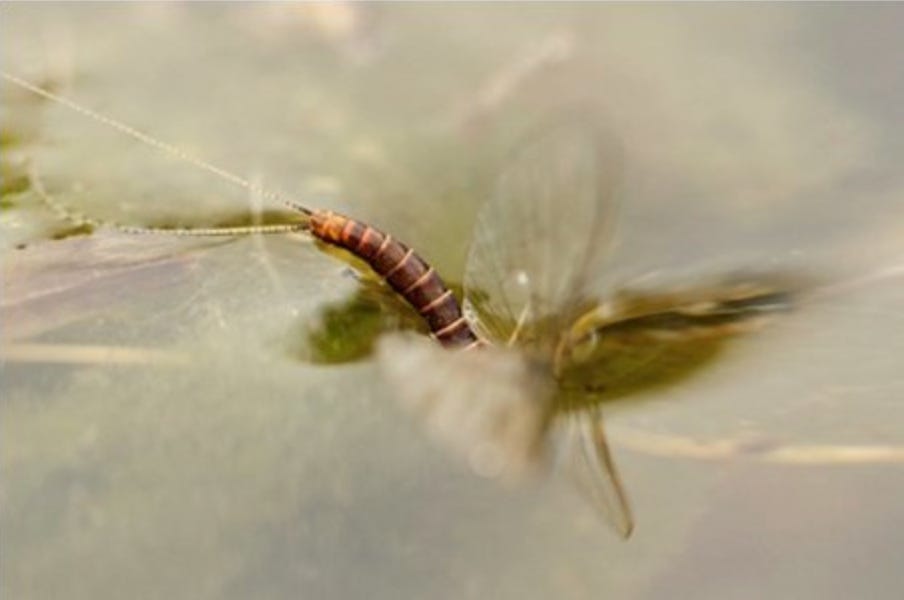
Some bugs such as Baetis and some caddis lay their eggs by crawling or diving into the water. After they’ve laid their eggs they drift in the water column. Here’s a neat picture of a Baetis imago entering the water (by Michel Sartori)
Another reason for behavioral drift is to escape predation, whether from fish or other creatures including carnivorous invertebrates.
Behavioral drift is what accounts for the mass drifting of bugs in non-catastrophic conditions. But there are some interesting effects that have been noted about behavioral drift. The first, and possibly most important, is that the presence of trout has a huge impact on the nature of behavioral drift.12 The presence of trout causes a large shift towards bug drift happening at night, and the daytime drift is of smaller bugs. The next is that trout activity is sort of ambiguous with respect to the drift. So even though the drift is highest at night, the fish themselves may be more active during daylight hours.
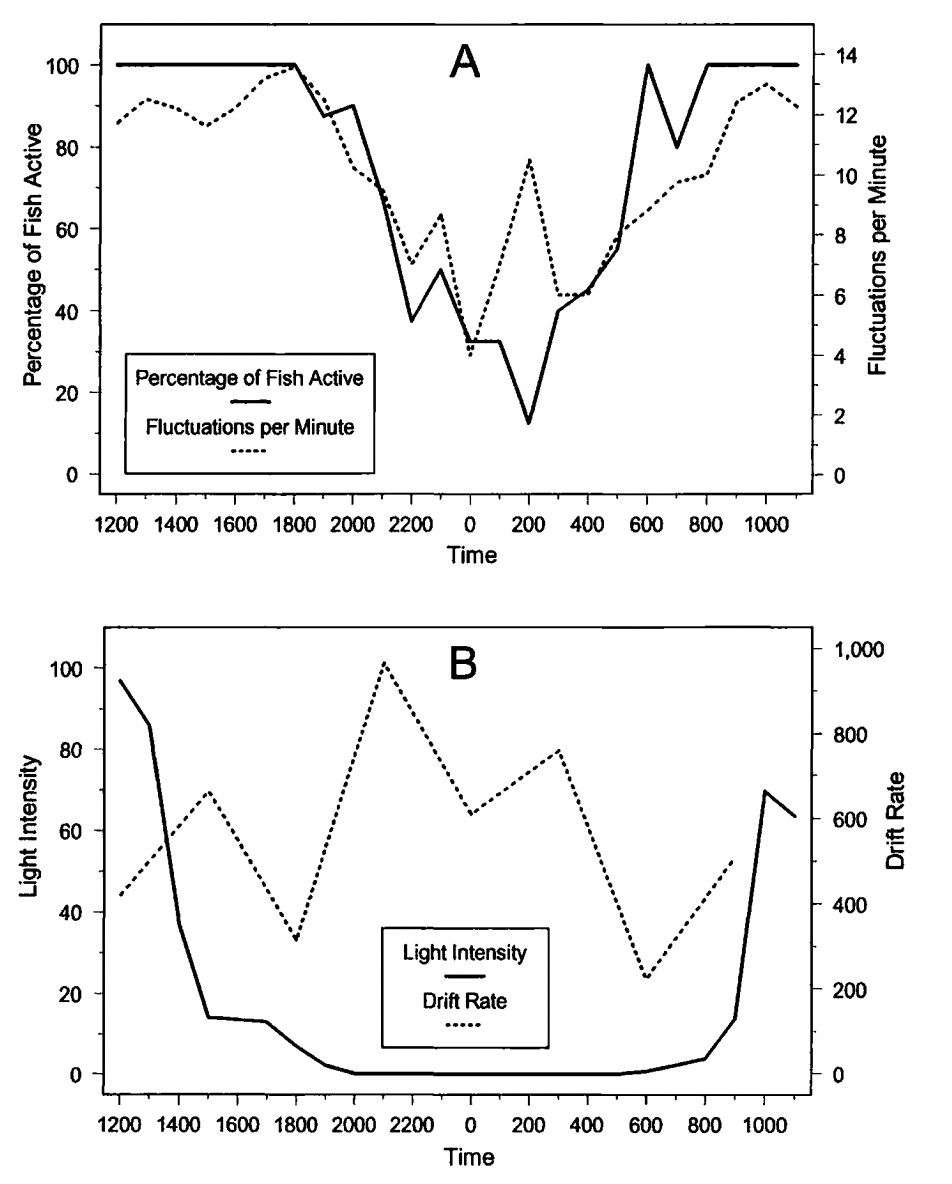
However, there is one thing that is remarkable. Even though the percentage of bugs drifting is smaller during the day, and the bugs drifting are smaller, the trout seem to feed more on the few bigger bugs that are present.34
One interesting bit of behavior is how the diet changes with water type. Here are the drift rates in an extremely fertile stream during some random hour.
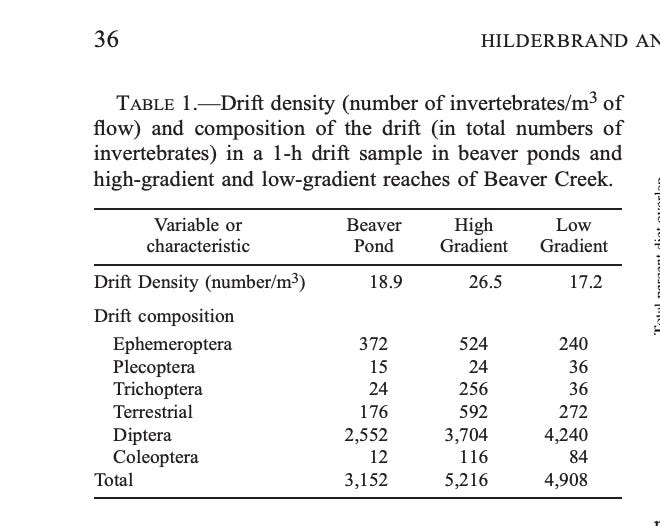
Of note is the fact that midges (diptera) make up 75-85% of the overall drift, mayflies 5-10% and so on. And when you look at the consumption by trout:
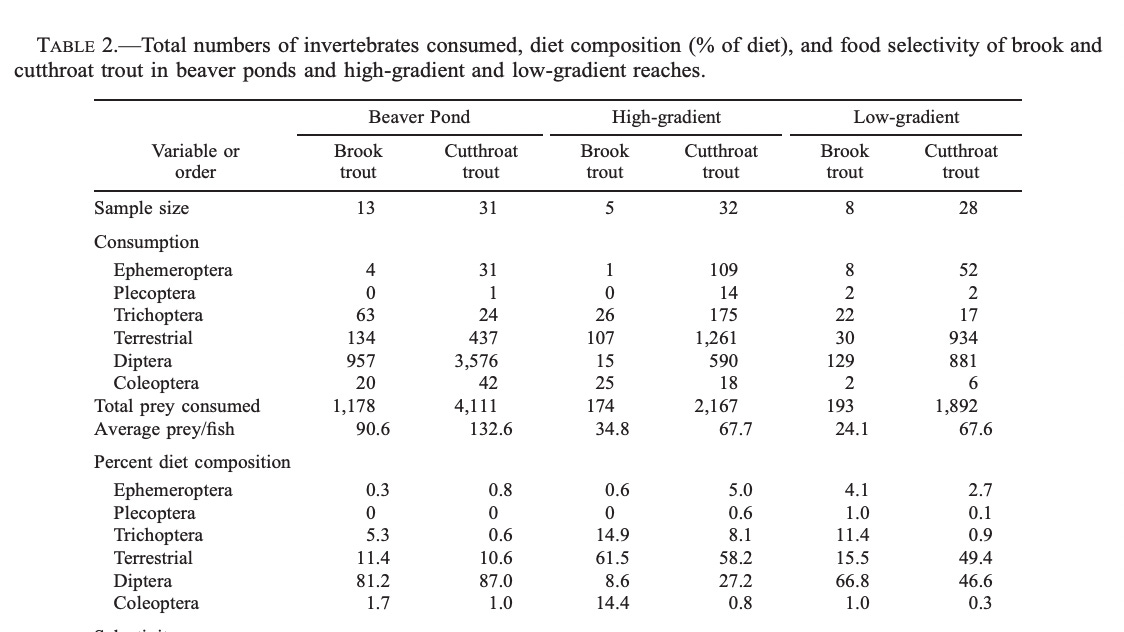
You notice that as the water starts moving, and the faster it moves the less the fish seem to feed on the midges. In the high gradient sections the consumption is about 25% or less than the availability of the diptera. I suppose possible reasons are that the smaller bugs are less visible and cost more to eat. But that’s pure speculation. The only known thing is that the trout are keying in on bigger bugs in faster water.
So, how does all of this affect the flies we use to catch fish.
Impact of Drift on Trout Feeding Habits
From the above tedium we arrive at a few conclusions. First, unless there’s a hatch or pre-hatch activity going on, there is very little behavioral drift of bugs in the daytime, when most of us fish. And what drift there is during the day is made up of smaller bugs, but the trout seem to be feeding on the fewer bigger bugs during that time. And there you have it - the secret to choosing productive nymphing patterns.
There are some streams where the numbers of species present is low. For instance the Pennsylvania limestoners have a few species of mayflies and caddis but large numbers of scuds and cressbugs. Some Western streams are dominated by caddis and stoneflies with maybe the odd BWO or PMD population. In such streams the trout get acclimatized to seeing very few identifiable food forms. Other rivers may have 30, 40 or even more taxa in reasonable numbers. But most of these drift at night. In such streams a trout will feed on whatever it can get during the day.
The studies show that even though there are fewer of them, the trout seem to feed more on the bigger bugs. And I think that makes sense. For the most part, in moving water trout are drift and ambush feeders. They lie and wait for the food to come to them. Gary Borger in his book “Reading Waters” talks about different types of lies trout will hold in. But the gist of it is that trout lie waiting for food to drift by. Since the drift is relatively low in numbers the best lies are where the food gets concentrated. But even there the number of bugs drifting by isn’t very large.5 So trout must catch whatever they can. If you watch trout in their feeding lies you’ll see that they move around quite a bit both side to side and up and down grabbing things floating by.
What an angler needs to do is try and make his fly one of the things the trout grab. Obviously, if you put a natural looking fly, close to the trout’s nose it will grab it. But that’s a low probability play. What you need to do is use a fly that has the ability to get a trout to grab it over a wide swath of the stream cross section. If you went into a fly shop 45 years ago you’d see a bunch of nymphs that looked like this.
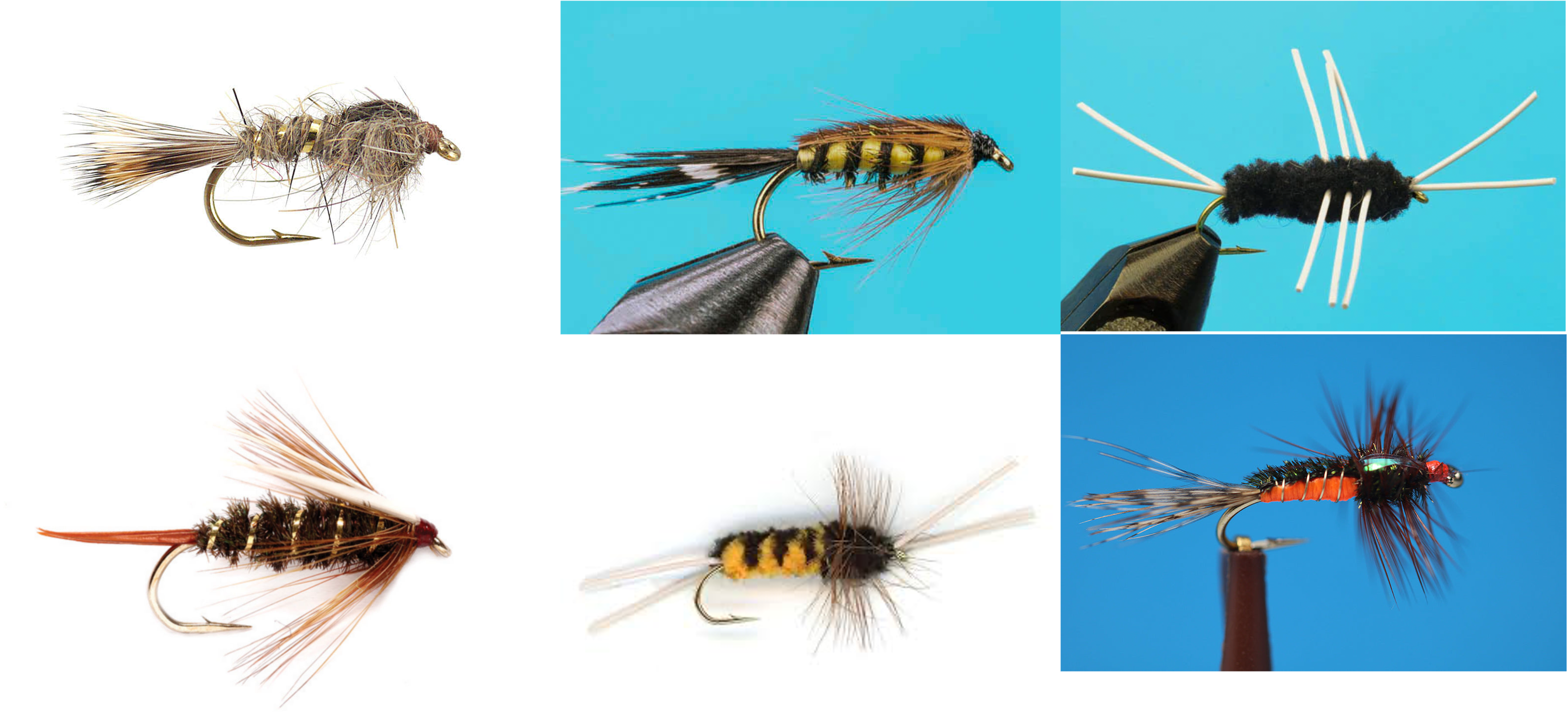
These fly designers may have convinced themselves and the users that their nymphs worked because the imitated something. But if the trout are as selective as we sometimes tell ourselves they are, what in the name of all that’s holy did they take a lump of black chenille with white rubber bands hanging off it for? Today, 45 years later, the situation seems to have actually become even more dramatic from that point of view. If you go to the Orvis website and look at their nymph section here are the first 6 flies you see.
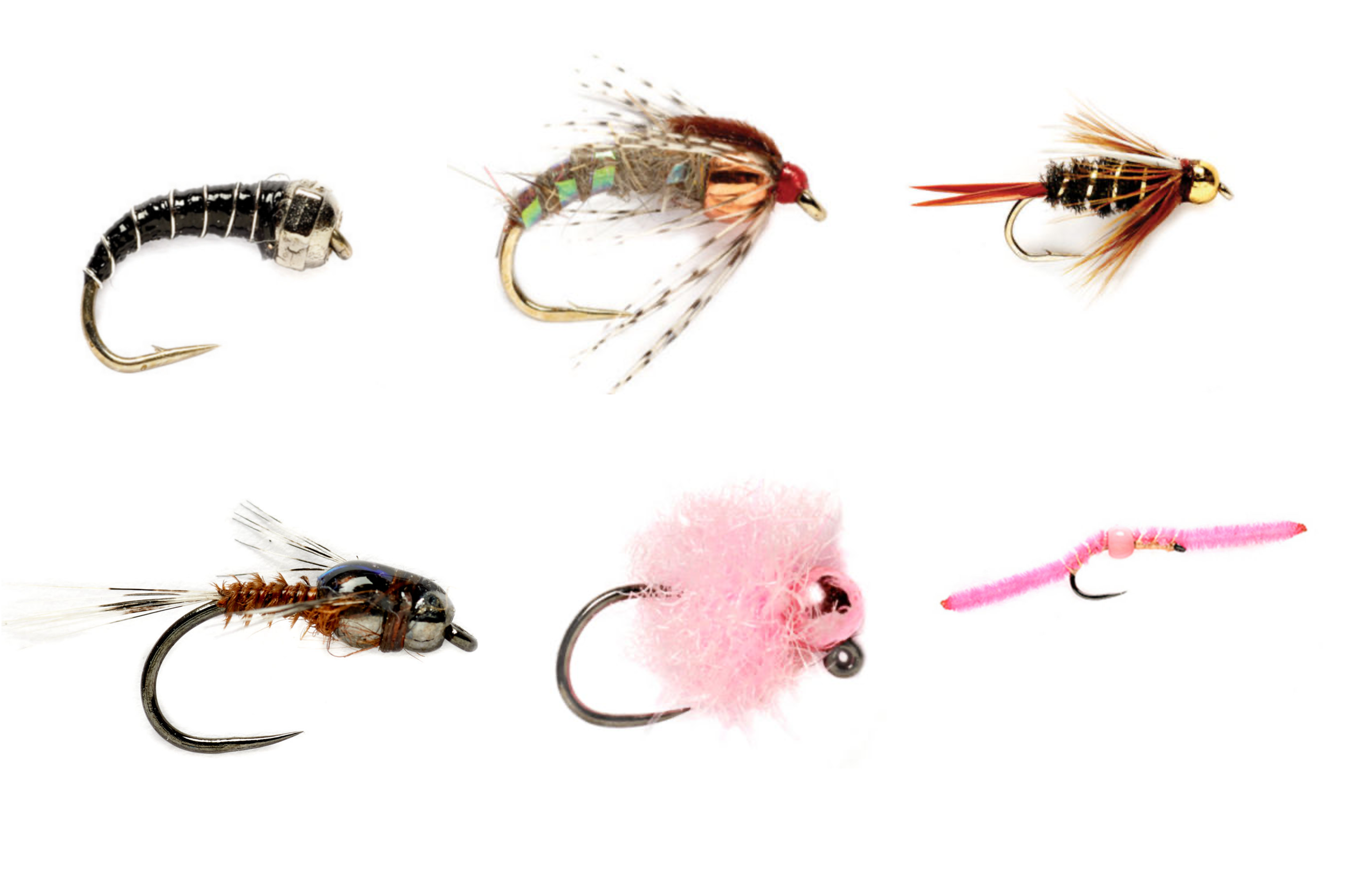
And if that wasn’t enough take a look at the first 6 patterns in their Euro Nymphs section (the current craze). Actually the last one isn’t in the top 6 but I had to throw it in there to make a point.
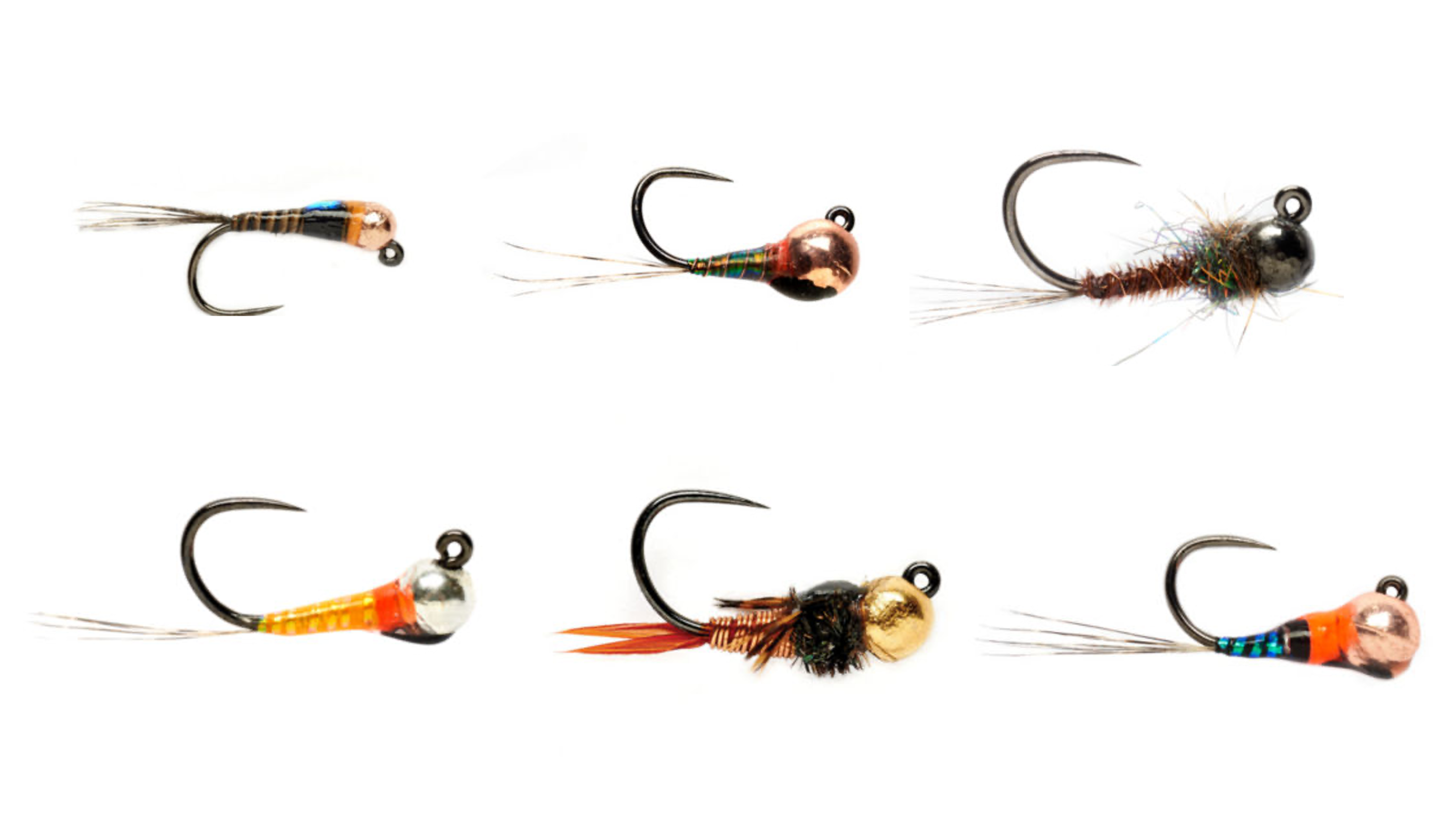
The folks peddling this stuff will tell you to use fluorocarbon tippet material because it’s less visible and yet their flies have “headlights like a northbound train shining its light through the cool Colorado rain.” And all of that actually makes sense, because what you’re trying to do is get the attention of the fish over as large an area as you can. The vivd colors and shiny beads probably achieve that very well. This is probably also why the trout seem to eat more of the bigger bugs - because they can see them from further away.
From all of the discussion above it would seem that unless there is a concentrated behavioral drift going on we are dealing with the concept of attracting fish to our flies. Because trout can show selective behavior we tend to think they’re always selective. Even to the extent of trying to attribute imitative qualities to our attractor patterns. How many theories have you heard of about what a fly like a Sexy Walt’s Worm imitates? This thing.
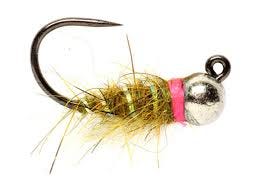
I think it imitates exactly nothing. I bet if a trout caught on one of them could speak it’d probably say, “I just wanted to see what that weird thing was!” It’s the same thing with streamers. Most of that stuff isn’t imitative. If you can pass it off as imitative then how do you reconcile it with a trout being selective to a #24 BWO? If this actually looks like a baitfish, then…….
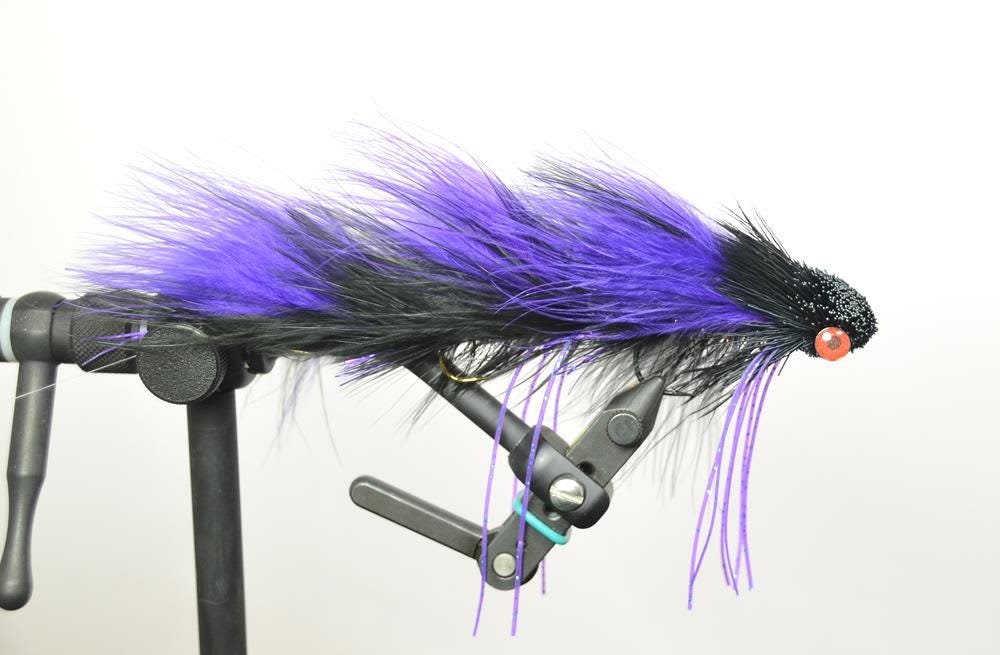
And the fact is that unless there is some critical mass of a given type of bug drifting by it trout are just opportunistic feeders. And I think sometimes they grab things just for curiosity’s sake. When I was a kid we lived by a spring creek that had a section in a park set aside as a trout propagation area. This place held some massive browns. The park had these trails running through it with little foot bridges over the stream. I’d go stand on those bridges and toss little odds and ends into the stream. Juniper and pyracantha berries, crumpled little bits of paper, bits of shiny cigarette package or gum wrapper foil I’d scavenged from somewhere and those sorts of things. As soon as I would get to something the trout couldn’t have seen on a regular basis I’d get one fish after another go up and mouth whatever I’d thrown in. They’d spit it out immediately, but often it would drift down a run and I’d see 3 or 4 fish grab it in turn. If that was a fly, I’d have them and it wouldn’t matter why they grabbed it. And I suspect that’s what a lot of the fishing to opportunistic trout is all about.
Attractors
An attractor fly, any attractor fly must firstly attract the fish’s attention, then it must then make the fish grab it - for whatever reason. Streamers may attract attention by the effects of motion, the pressure waves and such due to motion and their visual aspects. But dead drifted nymphs have to rely almost entirely on the visual aspects. Because that is so, unless there is an active behavioral drift going on, they must be attention catching visually. That means they have to be readily visible in the environment being fished.
Size matters. Bigger flies are more readily seen in roiled or stained water. Obviously you have to keep them within reason. No trout is going to go for a #2 stonefly nymph where there are no stoneflies. Secondly they must attract the fish’s attention when compared to the myriad of other things floating by. Color, flash, fluorescence and potentially motion enhance that visual attraction.
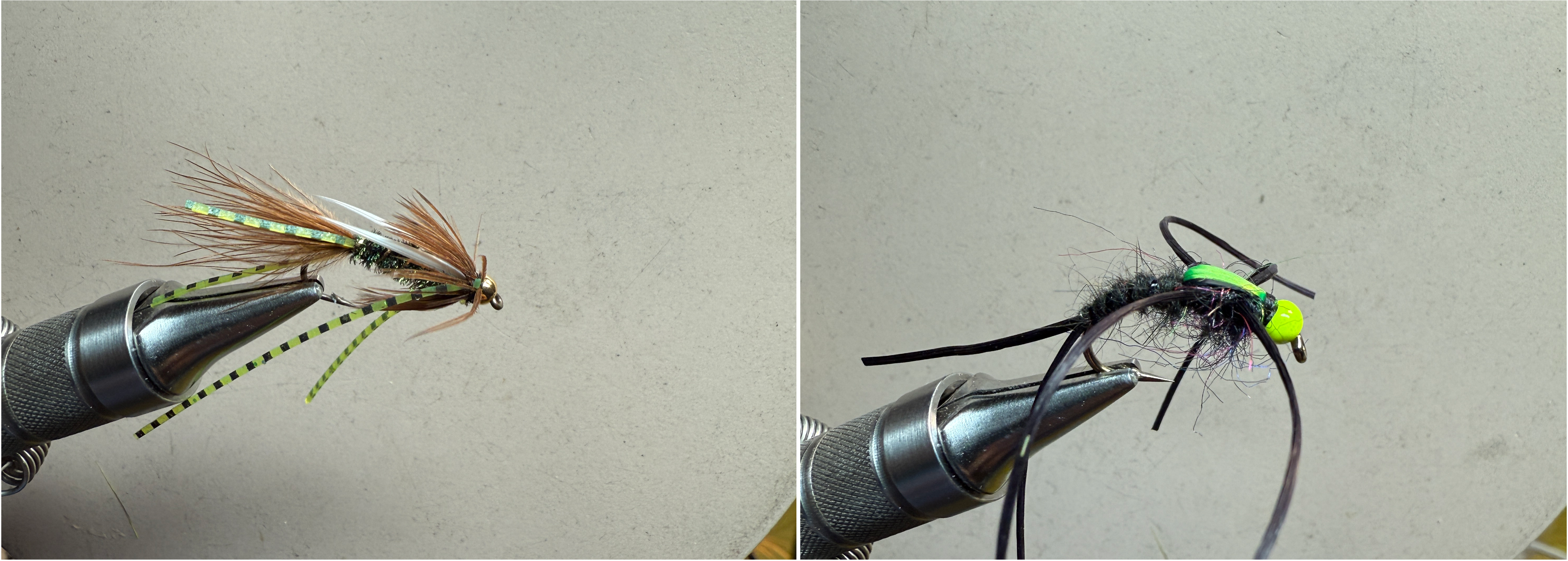
The Mega Prince with its marabou tail and soft hackle and other rubber leg stonefly imitations are a great example of flies that attract through size and motion. I even add a little color to the stonefly nymph to add a little more attraction.
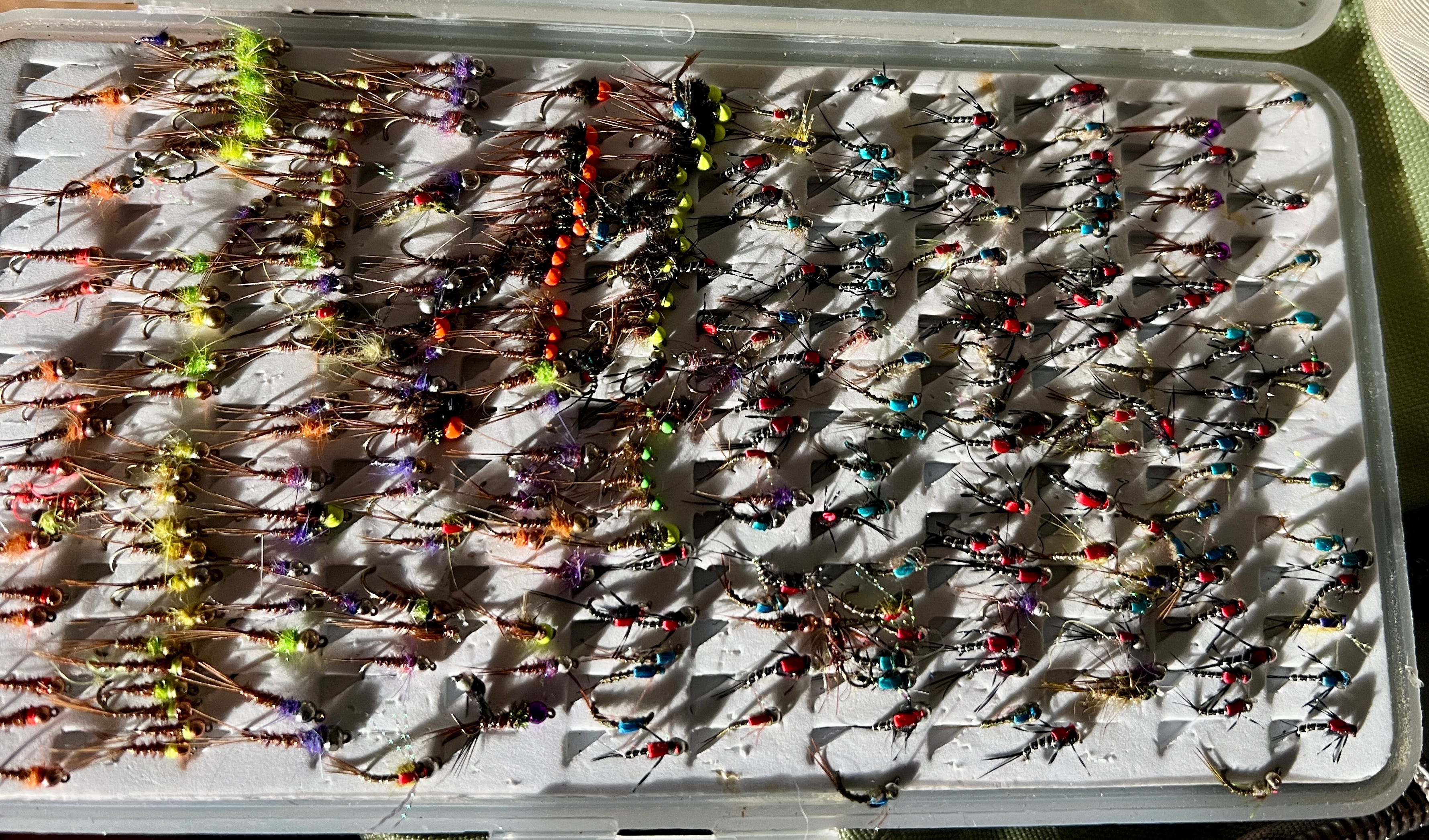
Or even soft hackle wet flies that produce fish at all times of the year. I have whole boxes of them in various forms but all with soft webby hackle and some attractor quality in the thorax. (This box is showing winter baldness that needs fixing).
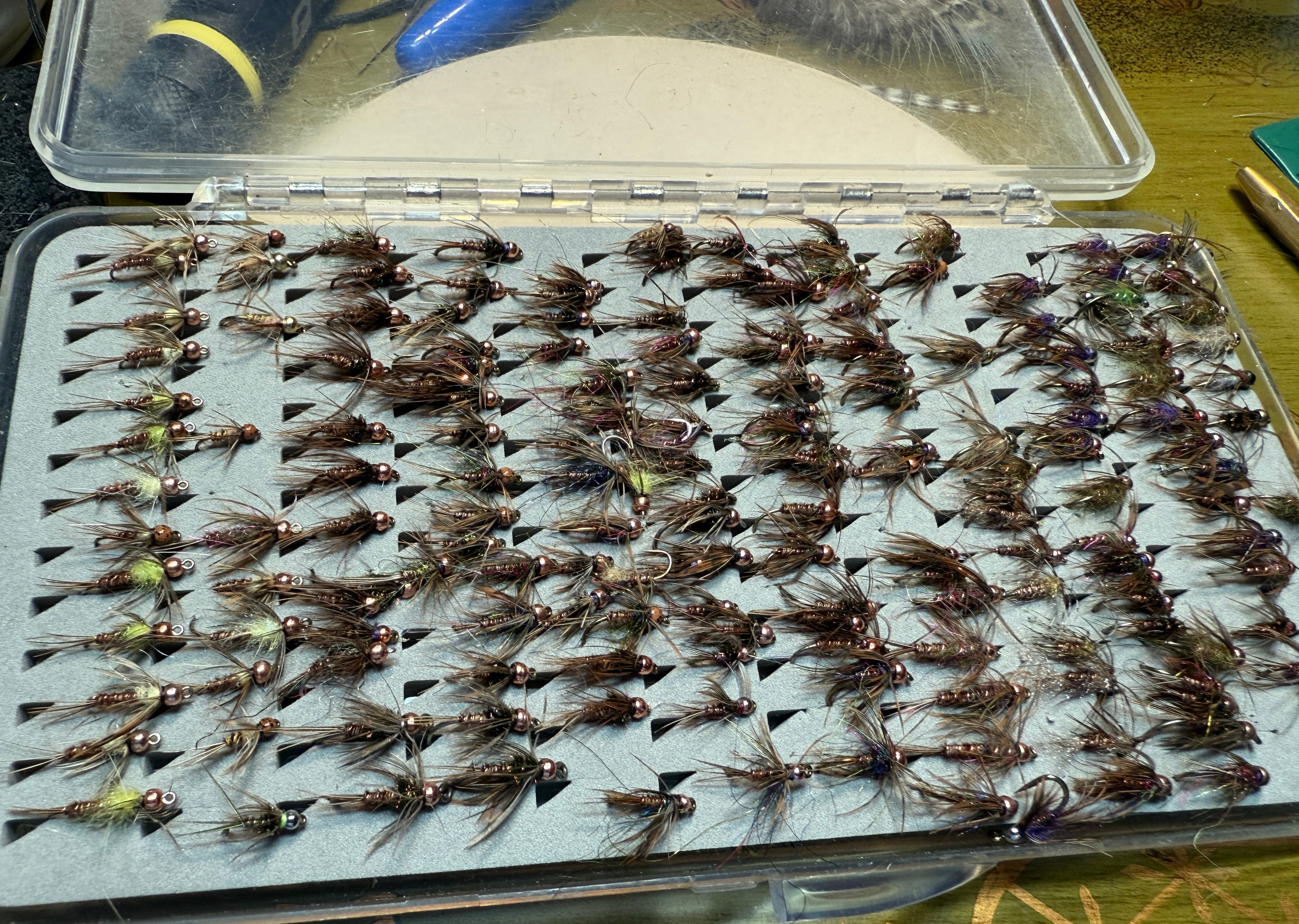
I believe color is very important. A drab brown or gray nymph drifting in a stream may not stand out from far enough away to readily draw a fish’s attention. But as I had discussed in another post last week light conditions and color can be very important qualities for success with an attractor pattern.

That’s probably the reason for the success of nymphs such as the Frenchy or hot head Pheasant Tail. For the colors go refer to the trout color sensitivity in the older post linked above.
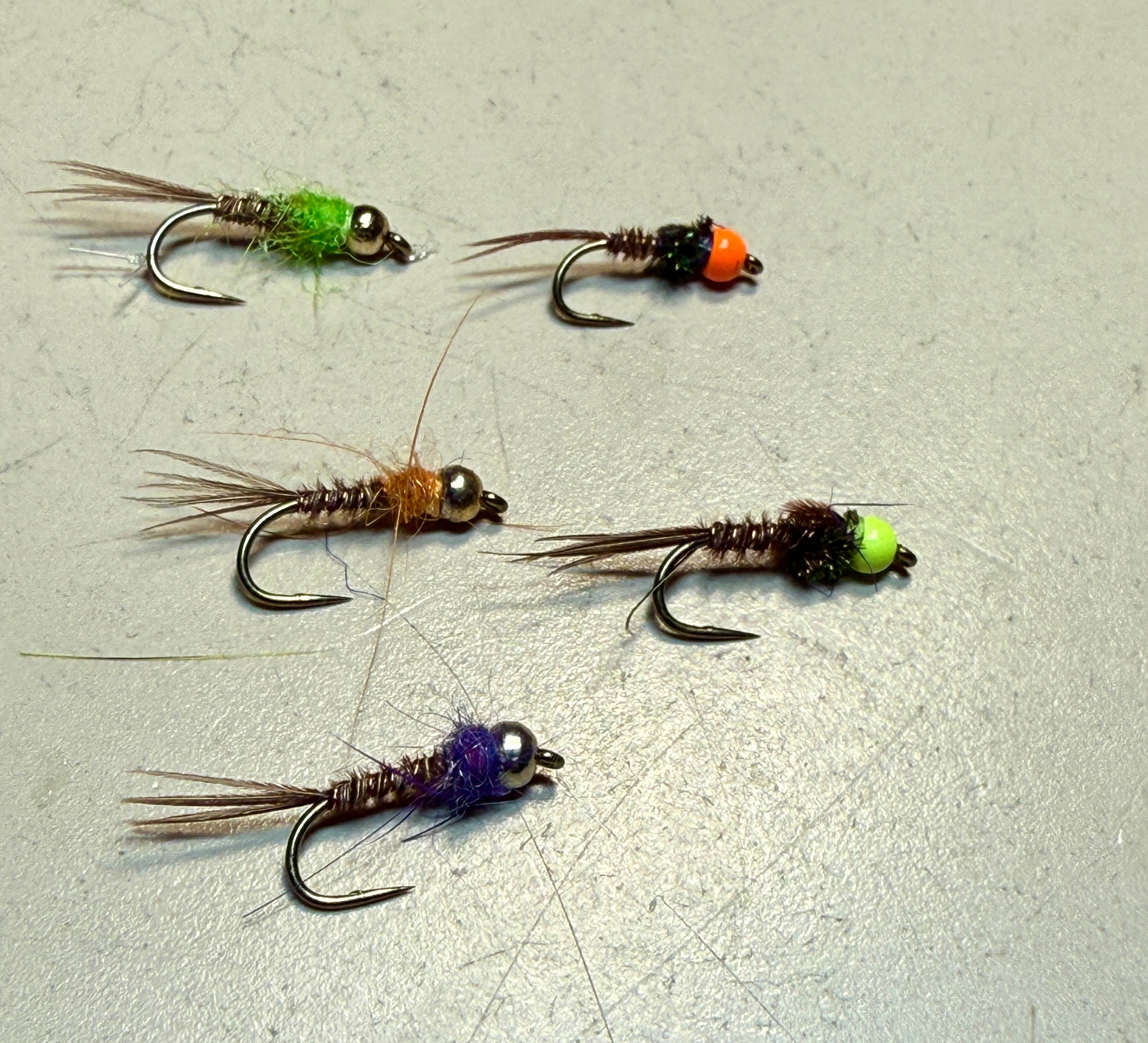
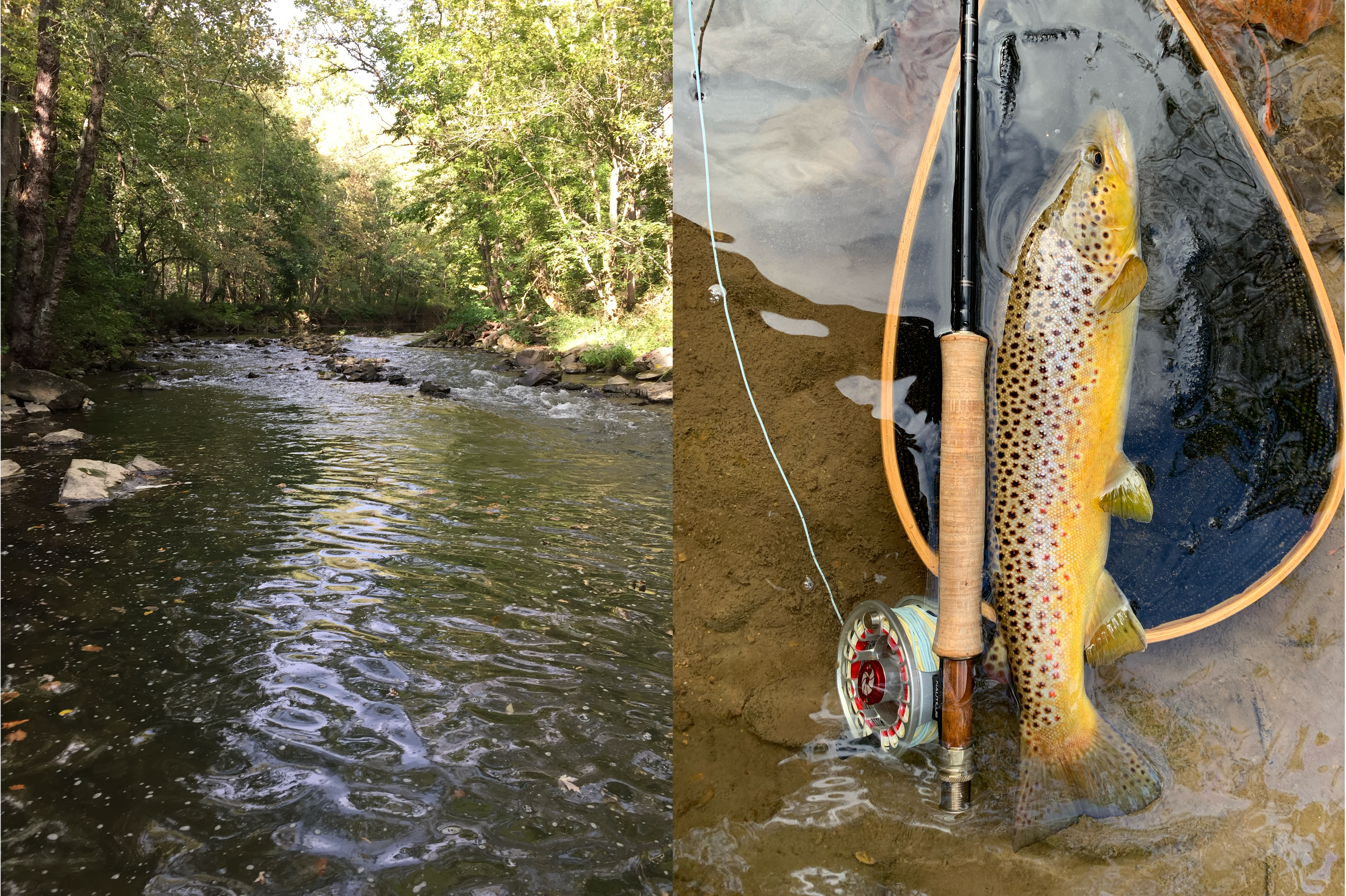
Both of these chunky browns fell to a #14 UV blue thorax Pheasant Tail in late winter.
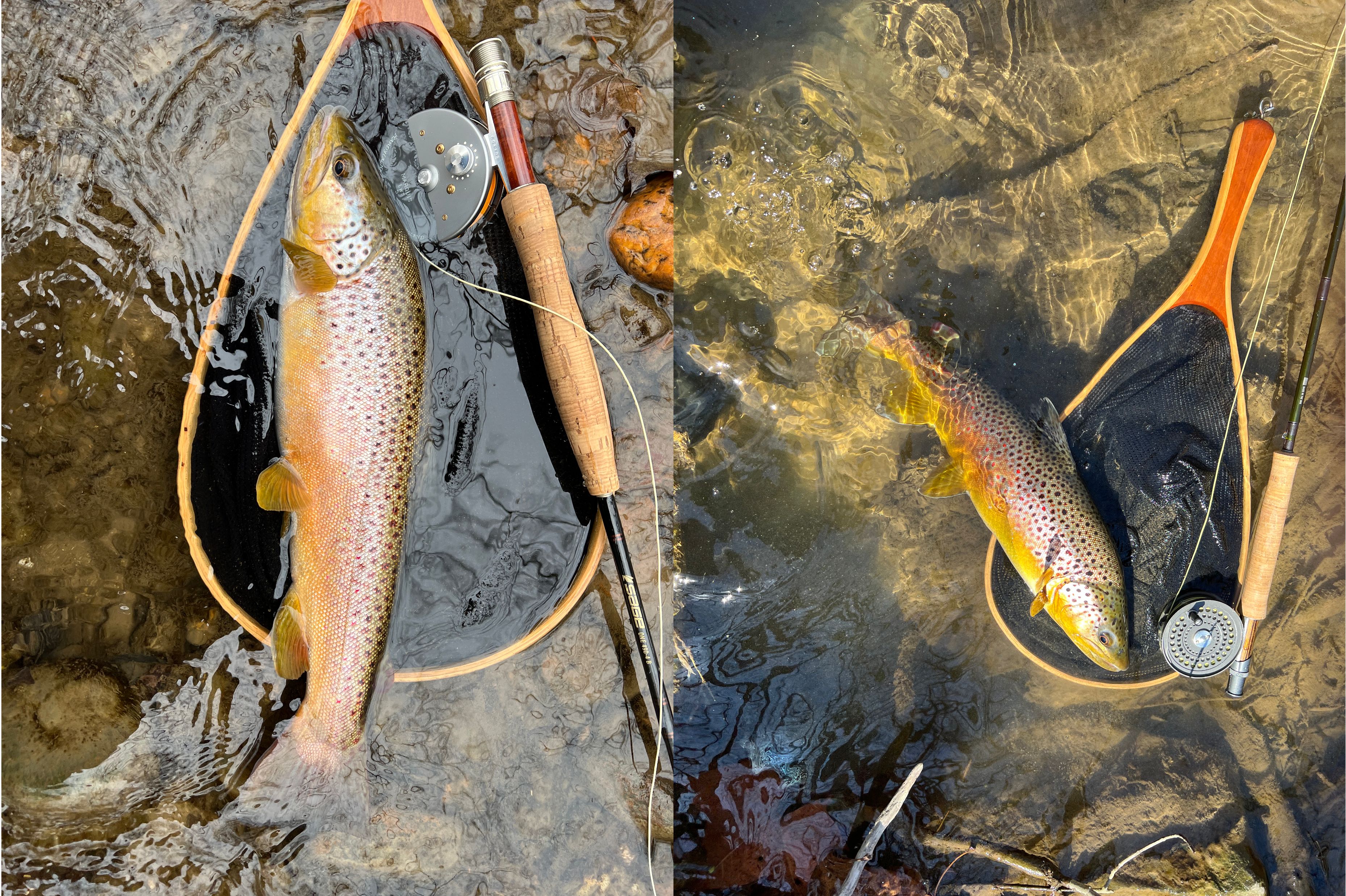
Because of the limited behavioral drift during daylight hours most fishing at that time is done to either opportunistic feeders or fish who should have talked to cats about the outcome of curiosity.
But all that changes once you have an abundance of naturals in the drift.
Imitators
As a single food organism starts becoming more prevalent fish tend to become keyed in to that item. I suspect this isn’t anything more than an efficient search mechanism based on a match to an imprinted pattern. That’s why you will find that fish seem to become more selective as the hatch progresses. During the first couple of days of a hatch one can catch the fish on a variety of patterns. As more days go by the successful flies start showing a critical set of features. That isn’t the fish getting smarter. I suspect it’s just the trigger points getting imprinted. This applies to subsurface as well as surface flies. Gary LaFontaine talked about the bubble on emergent sparkle pupa. He also talked about how a Brachycentrus pupa drifts hundreds of feet. When the caddis hatch starts looking like this the trout have to see a gazillion pupa drifting by them before the surface activity starts.
The pupa start forming an air bubble as they drift and eventually rise to the surface. That’s what a LaFontaine Sparkle Pupa imitates. His original pattern was done before bead heads became common. But a bead adds another dash of sparkle to the fly. Here’s my take on a Brachycentrus Pupa. It works.
In the passing I’ll point you to LaFontaine’s discussion on fishing the larva for this type of caddis.
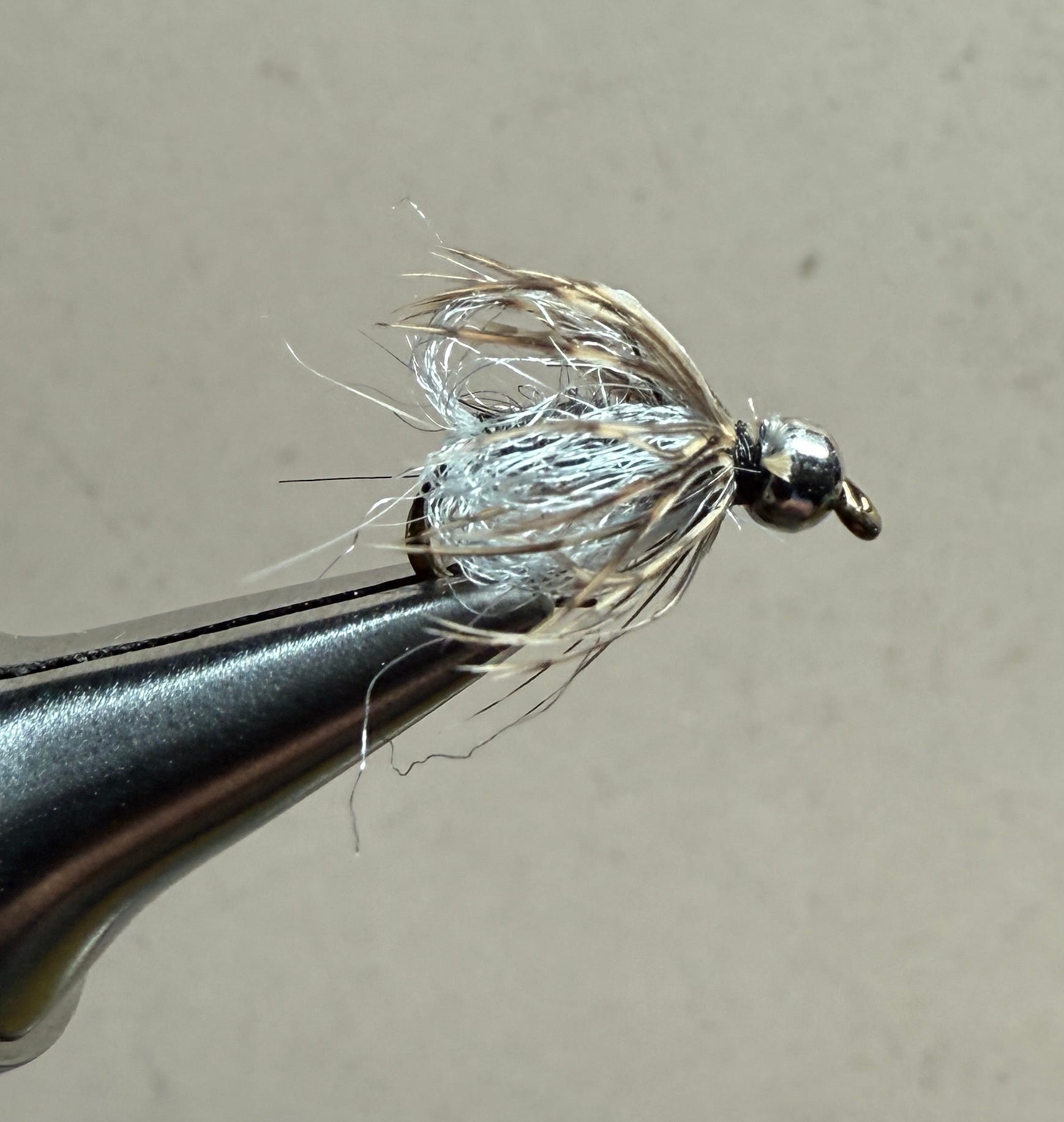
And here’s my fishing buddy expressing his mystification at a lack of rising fish during a Sulphur (Ephemerella Invaria) hatch. But imagine what was
going on under the surface. That sort of abundance of drifting bugs has to make the trout key in to specific patterns, merely because that’s what’s drifting by them. Now you need to get your nymphs to start matching the naturals.
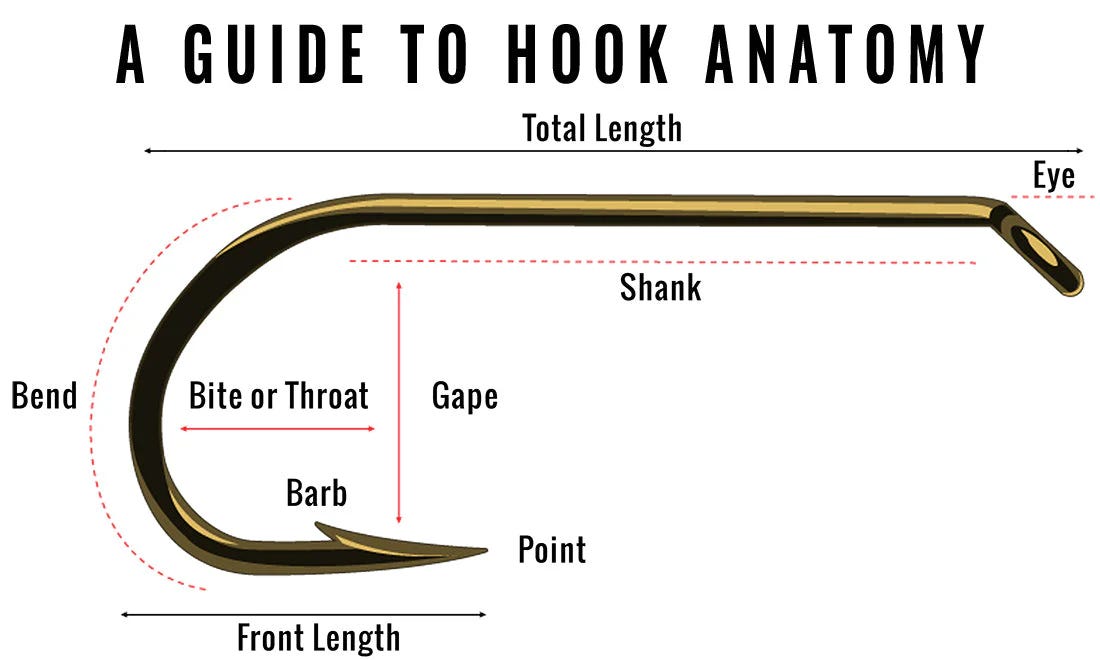
The first critical issue here is size. This hatch is the early season “Sulfur” or the Ephermerella Invaria. In the East this mayfly has a nymph that is nominally 8-11 mm long. If you were to use a TMC 100 (a standard dry fly hook, but I’m just using it for size representation) it would be about a #10-#14. The hook itself may be bigger but you want to measure just the shank. That’s the part the nymph occupies.
Also, since the trout in such a situation would possibly be selective try add in any prominent characteristics. The three bottom flies cover E. Invaria nymphs in different streams. The top fly is a #16 nymph I put in there for comparison. That’s what I find most folks fishing. And that’s why……….
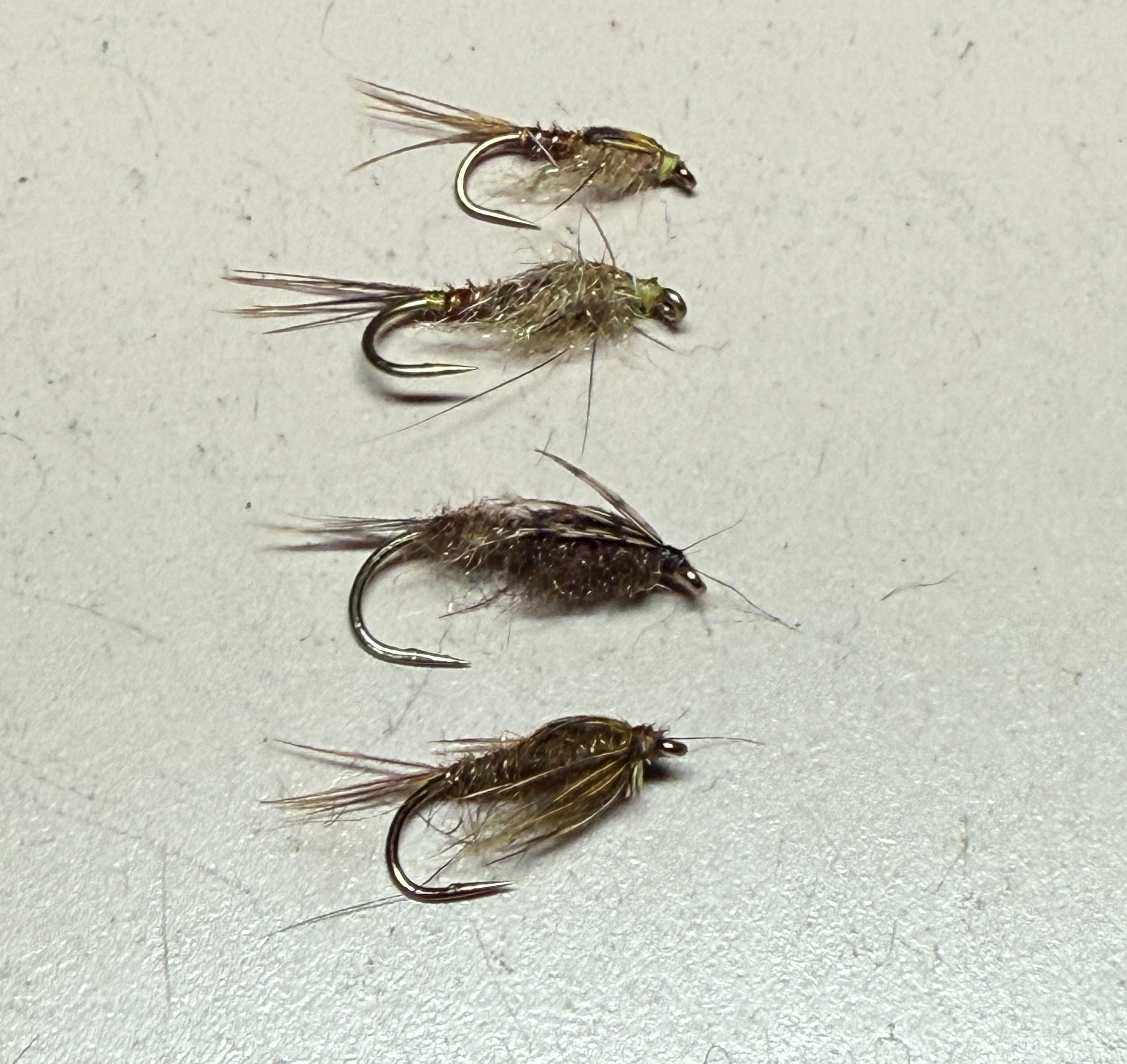
The bead heads are now gone, I’ve started getting a little more realistic, some sort of hackle has been tied in for legs, or the dubbing is picked out, and I do tie different color variants for different streams.
The dun would actually be bigger, but that’s a story for another day.
Prominent Taxa in Behavioral Drift
Almost all aquatic macro invertebrates show behavioral drift. But some do so a lot more than others. The most prolific drifters are members of the Baetis (BWO) family, Simulium (black fly) species, and Gammarus (scud) species. There are some Tricoptera (caddis) that also drift in large numbers, especially because they actually go through two underwater phases - larva and pupa and often drift to find suitable pupating sites. Everyone knows the Baetis family. The Simuliums are a little less well known and I would suggest you look them up. Blackfly larva and pupa are responsible for very prolific and selective trout feeding. Most black fly species are multi-brood over the course of the year. Those darting, dashing trout you see often billowing upward towards the surface and grabbing something could be feeding on either the larva or pupa.
Scuds, where they occur, are also extremely prolific drifters and the one taxon I find seem to drift in large numbers during the day. Everyone associates scuds with limestoners and occasionally tailwaters. But one should keep an eye out for them in all areas where there are aquifers with an alkaline geology. One of the streams I fish on a regular basis looks like an average woodland freestoner. And it is, but it has a lot of alkaline spring seeps. And it produces chunky buttery browns on scud patterns.
Forty years ago, as a grad student at the University of Maryland I worked in a fly shop and used to fish and guide people on the South-Central Pennsylvania limestoners such as the Letort, Falling Springs, Big Springs, etc. These spring creeks are teeming with scuds and cressbugs. Being a young student of scientific bend, the idea of pumping fish stomachs was very appealing. I found something remarkable when studying the stomach contents of those fish. Individual fish seemed to key in on one or the other. You could catch two fish lying less than 2 feet apart and one would be full of scuds and the other of cressbugs. This posed an odd dilemma. How did you know you weren’t fishing the wrong pattern to the wrong fish? That led to the invention of a pattern I called the APC or All Purpose Crustacean. Since then I have used it to decimate trout on the 3 continents where I’ve fished limestone or chalk streams.
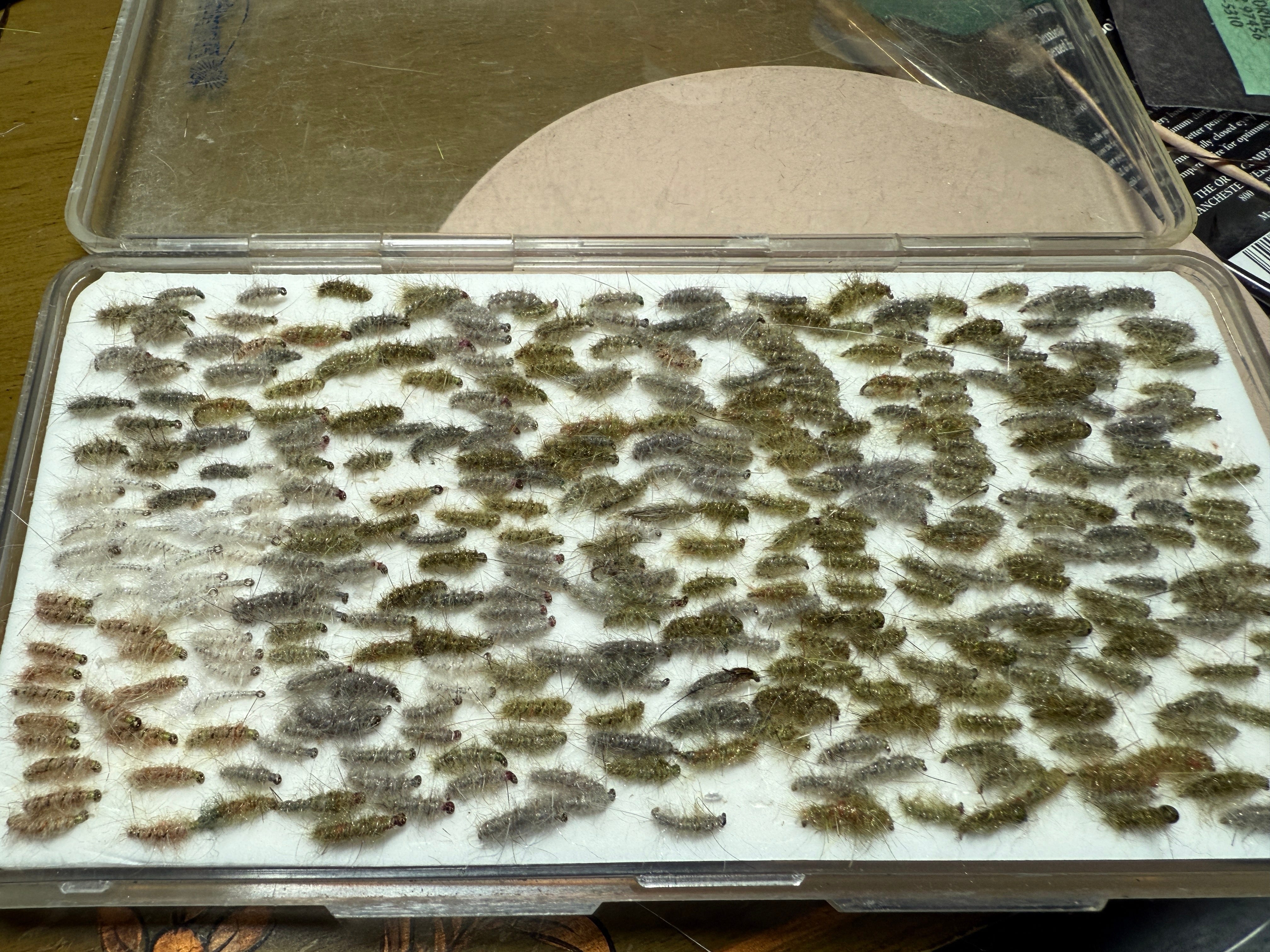
Here’s my shared secret in return for your having waded through this stuff. My box of APCs and an APC. There are three materials the thread, dubbing and wire. The dubbing is just a mix of rabbit and Antron blended to get the color you want. Tied on a curved shank hook and ribbed with fine silver wire. Pick out the bottom with a dubbing teaser. Don’t add a shellback, it actually seems to lower the effectiveness of the fly. Just trim the top flat with your scissors. And keep the fly slender in the top to bottom axis. Don’t flatten it out like people do for cress bugs. No weight, no beads, no nothing. Add some split shot to your leader and go to town. A white one makes a great Mysis shrimp imitation.
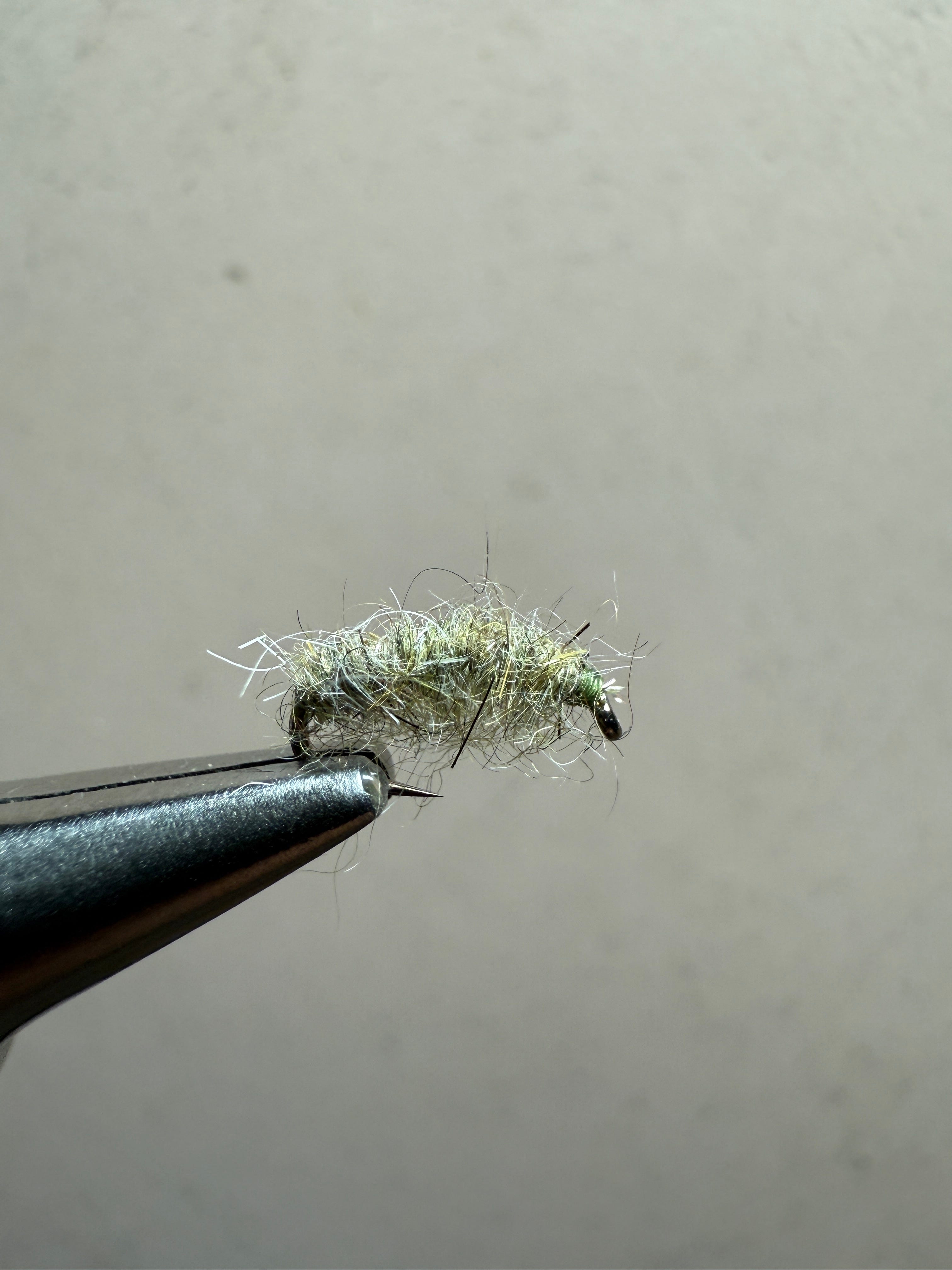
So, the gist of this long article is very simple. Catastrophic drift is irregular and infrequent. Behavioral drift happens mostly at night. Daytime trout are opportunistic feeders unless there is some hatch related activity going on, and they tend to feed more on the larger bugs, especially in faster water. Under those conditions a slightly larger attractor pattern will work wonders, and be careful of the ambient light color when choosing one.
When there is hatch related subsurface activity, the trout can get selective. So look to what is drifting and give them that. Now make the flies more muted and better imitators of the naturals. And watch the size. Smaller is rarely better.
Tight lines.
https://www.researchgate.net/publication/226408642_Effects_of_trout_on_the_diel_periodicity_of_drifting_in_Baetid_mayflies
https://www.aloki.hu/pdf/0601_049055.pdf
https://orbi.uliege.be/bitstream/2268/5854/1/JFB2000-drift.Pdf
https://www.researchgate.net/publication/227115171_Diel_and_density-related_changes_in_food_consumption_and_prey_selection_by_brook_char_in_a_New_Hampshire_stream
https://www.srs.fs.usda.gov/pubs/ja/ja_romaniszyn001.pdf